




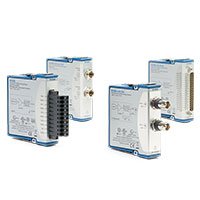


C系列 温度测量模块
NI C Series Temperature Measurement Modules
NI C Series Temperature Measurement Modules provide dedicated inputs for thermocouples, RTDs, thermistors and resistance-based temperature sensors. They install in compatible CompactDAQ and CompactRIO systems to support thermal validation, environmental monitoring, process measurement, reliability testing and long-duration data logging.
Temperature accuracy depends on the complete measurement path. In addition to the module, engineers must consider sensor type, wiring method, cold-junction compensation, excitation current, lead resistance, terminal accessories, local temperature gradients and calibration requirements.
What Is a C Series Temperature Measurement Module?
A C Series temperature measurement module is a specialized analog input module designed for a specific temperature-sensor architecture. It provides the signal conditioning, conversion and measurement functions required to obtain usable temperature data from low-level thermocouple voltage, RTD resistance, thermistor resistance or other supported sensor outputs.
Dedicated temperature modules are normally preferable to general-purpose voltage input modules because they can include functions such as cold-junction compensation, precision excitation, open-sensor detection, lead-resistance compensation and measurement scaling.
Do not select a temperature module only from the desired temperature range. Confirm the sensor type and its electrical interface first. Thermocouples, RTDs and thermistors use different measurement methods and are not interchangeable.
Temperature Sensor Input Types
Sensor Type
Electrical Output
Required Measurement Functions
Typical Applications
Thermocouple
Low-level voltage generated by dissimilar metal junctions
Thermocouple type selection, cold-junction compensation and suitable terminal connection
High-temperature testing, ovens, furnaces, chambers and process monitoring
RTD
Resistance that changes predictably with temperature
Precision excitation and 2-, 3- or 4-wire lead-resistance compensation
Precision thermal validation, laboratory measurement and industrial monitoring
Thermistor
Temperature-dependent resistance with nonlinear response
Compatible resistance range, excitation and sensor linearization
Electronics, medical, environmental and compact embedded systems
Resistance Sensor
Resistance output from a supported sensor or measurement element
Resistance range, excitation accuracy, lead compensation and scaling
Custom thermal sensors and resistance-based measurement systems
Conditioned Temperature Transmitter
Standard voltage or current from an external signal conditioner
Compatible voltage or current input range; external conditioning is already provided
Industrial transmitters, PLC interfaces and distributed process systems
Representative NI C Series Temperature Modules
Model
Unique Category
Key Differentiator
Best Fit
NI-9211
Thermocouple Input
Dedicated thermocouple measurement with integrated temperature-input conditioning
General thermal testing and lower-channel-count thermocouple applications
NI-9213
High-Channel-Count Thermocouple Input
Multichannel thermocouple measurement architecture
Thermal mapping, environmental chambers and large temperature-logging systems
NI-9214
Isolated Thermocouple Input
Thermocouple measurement designed for applications requiring isolation consideration
Industrial temperature monitoring and systems with ground-potential differences
NI-9216
RTD and Resistance Input
Resistance-based temperature measurement for RTDs and supported resistive sensors
Precision temperature acquisition and resistance-sensor systems
NI-9217
RTD Input
Dedicated RTD measurement with lead-resistance compensation support
Accurate multichannel RTD measurement and thermal validation
NI-9219
Universal Temperature and Analog Input
Flexible support for multiple low-speed sensor and analog measurement modes
Mixed-sensor systems, prototyping and changing measurement requirements
This table represents common C Series temperature measurement architectures rather than every temperature-capable model. Verify the exact model, sensor support, terminal accessory, hardware revision and software compatibility before ordering.
How to Choose a C Series Temperature Module
1. Identify the Sensor Type
Start with the sensor datasheet. Determine whether the sensor is a thermocouple, RTD, thermistor, resistance sensor or externally conditioned transmitter. Record the sensor standard, nominal range, accuracy class, wiring method, cable length and required response time.
A Pt100 RTD, a Type K thermocouple and a 4–20 mA temperature transmitter may all measure the same process temperature, but each needs a different measurement interface.
2. Choose Thermocouple or RTD Measurement
Thermocouples are widely used for broad temperature ranges, high-temperature environments and rugged installations. They produce a small voltage and require cold-junction compensation. RTDs are commonly selected for stable and accurate temperature measurements but require excitation and lead-resistance compensation.
Select the sensor technology according to the required temperature range, accuracy, response time, installation environment and long-term stability.
3. Select the Correct Wiring Method
RTD wiring has a direct effect on measurement accuracy. Two-wire RTDs include lead resistance in the measurement. Three-wire RTDs compensate when the lead resistances are closely matched. Four-wire RTDs provide the best lead-resistance cancellation for demanding measurements.
For thermocouples, use the correct thermocouple extension wire, connector materials and terminal accessory. Replacing thermocouple wire with ordinary copper wire in the wrong location can create unwanted junctions and measurement error.
4. Check Channel Count and Sample Rate
Select the required number of channels and determine whether the system needs continuous logging, alarm monitoring, rapid thermal transients or synchronized measurements with other signals. Most temperature applications change slowly, but engine, battery, thermal-cycling and process applications can require faster update rates.
Verify the total scan rate and the timing behavior of the complete CompactDAQ or CompactRIO system. Multiple modules and channels can share system resources differently depending on the selected platform.
5. Review Isolation and Grounding
Temperature sensors installed across machinery, test fixtures and large industrial systems can be exposed to common-mode voltage and ground-potential differences. Isolation can help manage these conditions, but the isolation architecture must match the actual wiring and installation.
Review sensor grounding, cable shields, extension-wire routing, externally powered equipment and nearby high-current circuits before finalizing the module selection.
6. Build a Complete Accuracy Budget
Temperature accuracy is determined by more than converter resolution. Include sensor tolerance, sensor calibration, module gain and offset error, cold-junction compensation, excitation accuracy, lead resistance, self-heating, noise, environmental gradients and scaling uncertainty.
For regulated tests, long-duration monitoring and critical validation programs, also confirm calibration interval, traceability requirements and the method used to store or apply sensor calibration coefficients.
Thermocouple Measurement Considerations
Thermocouples produce a voltage based on the temperature difference between the measurement junction and the reference junction. The module must support the required thermocouple type and accurately measure the temperature at the point where thermocouple conductors connect to copper terminals.
Cold-junction compensation is therefore a system requirement, not merely a software setting. The terminal accessory, local airflow, enclosure temperature, connector material and thermal gradients around the wiring point can affect measurement accuracy.
Before selecting a thermocouple module, confirm:
Required thermocouple type, such as K, J, T, E, N, R, S or B
Expected minimum and maximum temperature range
Required channel count and logging interval
Terminal block and cold-junction compensation arrangement
Extension wire, connector type and cable routing
Open-thermocouple detection requirements
Grounded, ungrounded or exposed junction sensor construction
RTD and Resistance Measurement Considerations
RTDs provide stable resistance-based temperature measurements and are commonly used where good accuracy and repeatability are required. The measurement module supplies excitation current and measures the resulting resistance while compensating for lead resistance according to the selected wiring method.
Sensor self-heating can create error when excitation current dissipates heat in the RTD element. Consider the module excitation, sensor construction, mounting method, surrounding medium and required uncertainty when designing a precision system.
Confirm the RTD standard, nominal resistance, temperature coefficient, wire count, lead length and sensor accuracy class. A Pt100 and Pt1000 sensor are not interchangeable without checking the module’s supported resistance ranges and configuration options.
CompactDAQ and CompactRIO Compatibility
C Series temperature modules can be used in compatible CompactDAQ systems and CompactRIO systems. Compatibility depends on the exact chassis or controller, module model, driver version, sample mode and required timing configuration.
CompactDAQ is well suited to sensor logging, laboratory testing and portable measurement. CompactRIO is appropriate when temperature data must be integrated into an embedded real-time system, deterministic control loop or FPGA-based application.
Software and Connectivity
CompactDAQ temperature systems commonly use NI-DAQmx for device discovery, channel setup, sensor scaling, timing and data acquisition. NI Measurement & Automation Explorer can be used to identify supported hardware, inspect configuration and run available diagnostics.
CompactRIO systems can require NI-RIO, LabVIEW Real-Time and LabVIEW FPGA depending on the controller, chassis and application architecture. Confirm the software version before replacing a legacy module or deploying a new temperature measurement system.
The terminal block and cable should be treated as part of the measurement assembly. Temperature accessories can include cold-junction sensors, screw terminals, miniature thermocouple connectors and resistance-measurement wiring arrangements that cannot be replaced by a generic breakout cable.
Typical Applications
Environmental chamber and thermal-cycle testing
Automotive powertrain, battery and vehicle validation
Electronics thermal characterization
Industrial process and machine temperature monitoring
Oven, furnace and heat-treatment measurement
Energy, power-electronics and renewable-energy testing
Laboratory research and material testing
HVAC, refrigeration and climate-system validation
Long-duration sensor logging and condition monitoring
Embedded real-time thermal control systems
C Series Temperature Module Procurement Guide
Provide the following information for accurate module selection and quotation:
Sensor manufacturer and complete sensor model
Sensor type: thermocouple, RTD, thermistor, resistance sensor or transmitter
Thermocouple type or RTD standard, such as Pt100 or Pt1000
Expected temperature range and required accuracy
Required channel count and future expansion requirement
2-, 3- or 4-wire RTD configuration, if applicable
Required sample rate, logging interval and test duration
Isolation, grounding and common-mode conditions
Existing CompactDAQ chassis or CompactRIO controller model
Required terminal blocks, thermocouple connectors and extension cables
Operating system, NI driver and software version
Calibration, traceability and documentation requirements
New or pre-owned hardware preference
FAQ
What is the difference between a thermocouple module and an RTD module?
A thermocouple module measures low-level thermocouple voltage and uses cold-junction compensation. An RTD module measures resistance using precision excitation and lead-resistance compensation. They use different electrical measurement methods.
Can a voltage input module measure a thermocouple?
It can measure thermocouple voltage in some cases, but it does not automatically provide accurate cold-junction compensation, thermocouple scaling or appropriate terminal design. A dedicated thermocouple module is normally the preferred solution.
Should I use a three-wire or four-wire RTD connection?
Use three-wire RTD wiring when the lead resistances are closely matched and the required accuracy permits it. Use four-wire wiring when the best lead-resistance cancellation is required, especially with long leads or precision measurements.
Why is cold-junction compensation important?
Thermocouples measure temperature difference rather than absolute temperature directly. Cold-junction compensation measures the temperature at the terminal connection so the system can calculate the actual measurement-junction temperature.
Does temperature measurement require simultaneous sampling?
Usually not, because temperature changes slowly. Simultaneous timing becomes more important when temperature channels must be correlated precisely with fast electrical, vibration, force or control signals.
Can temperature modules be used with CompactRIO?
Yes, when the module is supported by the selected CompactRIO controller or chassis and the software architecture is compatible. Confirm the exact controller, module, driver and required timing configuration.
Related NI C Series Solutions
Explore the complete NI C Series module range for analog, digital, communication and dynamic-signal I/O. Pair temperature modules with a compatible CompactDAQ chassis for PC-based acquisition, or a CompactRIO controller for embedded real-time and FPGA applications.
NI C Series Temperature Measurement Modules from PXISOURCE
PXISOURCE supports engineers, system integrators and procurement teams with temperature-sensor interface identification, C Series module selection, CompactDAQ and CompactRIO compatibility review, terminal accessory matching and legacy-module replacement. Send the sensor datasheet, wiring method, channel count, required accuracy, existing platform model and preferred hardware condition for a technically matched quotation.
Need help selecting an NI C Series temperature measurement module? Email [email protected] or contact PXISOURCE on WhatsApp.